Disclosure: This post contains affiliate links. If you click a link and make a purchase, we may earn a commission at no extra cost to you. We only recommend products we trust.
When you’re miles from civilization with failing light and a shelter to build, your paracord becomes worthless without the knowledge to use it effectively. The difference between a secure shelter and a collapsed tarp in a storm often comes down to knowing just a handful of essential knots. While countless knot variations exist, survivalists who master five fundamental paracord knots can handle nearly any wilderness scenario with confidence and efficiency.
Why Paracord Knot Mastery Matters in Modern Survival
Paracord has evolved from military parachute suspension lines into the most versatile tool in modern survival kits, with the outdoor recreation market showing consistent growth as more people seek self-reliance skills. Recent surveys indicate that over seventy percent of outdoor enthusiasts carry paracord but fewer than thirty percent can tie more than two functional knots under pressure. This knowledge gap transforms a potentially life-saving resource into dead weight when emergencies strike. The ability to quickly tie secure, appropriate knots separates prepared survivalists from those who merely carry gear.
The stakes become immediately clear when you consider real-world scenarios where knot failure leads to equipment loss, injury, or worse. A poorly tied knot securing a bear bag can result in lost food supplies. An inadequate lashing on a shelter ridgeline means exposure to elements during critical overnight periods. A failed anchor point while crossing difficult terrain can lead to dangerous falls. Each of these situations stems not from equipment failure but from knowledge gaps that proper training eliminates. Understanding which knot serves which purpose and executing it correctly under stress represents fundamental survival competency.
Modern paracord specifications have also raised the bar for what’s possible in the field. Military-grade 550 paracord with integrated survival strands offers tensile strength exceeding six hundred pounds, but this capability only matters when proper knots maintain that strength under load. Certain knots reduce rope strength by up to fifty percent through improper stress distribution, while others maintain nearly full breaking strength. Learning the mechanical principles behind knot performance allows you to make informed decisions about which techniques to deploy in high-stakes situations where failure isn’t an option.
Understanding Paracord Knot Mechanics and Categories
Before diving into specific techniques, you need to understand how knots actually work and why certain designs succeed where others fail. Every knot functions through a combination of friction, compression, and mechanical advantage. When you create bends and loops in cordage, you’re essentially creating controlled friction points that resist slipping under tension. The geometry of these friction points determines whether a knot tightens under load, maintains consistent grip, or potentially fails catastrophically. Quality paracord features a kernmantle construction with an outer sheath protecting inner strands, and effective knots distribute stress across this structure rather than creating single failure points.
Knots fall into distinct functional categories that every survivalist should recognize. Loop knots create fixed or adjustable circles in your line, essential for anchor points, handles, and attachment systems. Bends join two rope ends together, critical when you need extended length or must repair damaged cordage. Hitches secure rope to objects like trees, poles, or gear, forming the foundation of shelter building and load securing. Stopper knots prevent rope ends from slipping through holes or unraveling, while binding knots cinch objects together tightly. Understanding these categories helps you select the right tool for each job rather than forcing inappropriate knots into situations where they’ll underperform.
The concept of knot efficiency deserves special attention because it directly impacts your paracord’s effective strength. A perfect rope with no knots maintains one hundred percent of its rated breaking strength. The moment you tie any knot, you introduce stress concentrations that reduce this capacity. Simple overhand knots can reduce strength by nearly half, while well-designed knots like the bowline maintain approximately seventy to eighty percent of original strength. This efficiency factor becomes critical when you’re using paracord at or near its load limits for applications like emergency rappelling, hauling heavy loads, or creating structural supports where failure could prove catastrophic.
Comparing modern synthetic paracord to traditional natural fiber ropes reveals important handling differences that affect knot performance. Paracord’s smooth nylon sheath provides less inherent friction than rough natural fibers, meaning some traditional knots that worked perfectly with hemp or manila rope may slip when tied in slick paracord. This characteristic demands either modified tying techniques or selection of knots specifically proven to grip synthetic materials reliably. Additionally, paracord’s elasticity under load means knots can shift and settle in ways that static natural fibers don’t, requiring you to dress knots carefully and sometimes add security wraps to prevent loosening during repeated loading cycles.
Five Essential Knots and Advanced Applications
The bowline stands as the single most valuable knot in any survivalist’s repertoire, creating a fixed loop that won’t slip or bind under load yet remains easy to untie after bearing extreme weight. To tie a bowline, create a small loop in your standing line with the working end passing up through it, then wrap the working end behind the standing line and back down through the original loop—remember the classic mnemonic of the rabbit coming out of the hole, around the tree, and back down the hole. This knot excels for creating anchor points on trees, forming rescue loops, attaching gear to pack frames, or any situation requiring a bombproof loop that maintains roughly seventy-five percent of rope strength. Advanced applications include tying the bowline one-handed for self-rescue scenarios or creating a running bowline for adjustable loops.
The trucker’s hitch transforms paracord into a powerful mechanical advantage system, effectively creating a pulley that lets you apply tremendous tension to secure loads or tighten shelter lines. Begin by tying a slip knot or quick-release loop in your line at the appropriate distance from your anchor point, then run the working end around your second anchor and back through the loop you created. Pulling on the working end generates a three-to-one mechanical advantage, allowing you to tension lines far beyond what hand strength alone permits. This knot proves invaluable for securing tarps drum-tight in high winds, lashing gear to vehicles or pack animals, or creating ridgelines that won’t sag under the weight of wet fabric. The quick-release feature means you can break down camp rapidly even after lines have been under tension for extended periods.
The sheet bend serves as your primary tool for joining two rope ends, particularly when connecting lines of different diameters—a common scenario when you’re working with various paracord types or need to extend length using whatever cordage you have available. Form a bight in the thicker rope’s end, then pass the thinner rope’s working end up through the bight, around behind both legs of the bight, and tuck it under itself. The double sheet bend adds an extra wrap for increased security with slippery synthetic materials. This knot maintains approximately sixty percent of the weaker rope’s breaking strength and proves essential when you need to create longer lines for bear bags, extended guy lines, or improvised climbing aids where single-length paracord falls short of requirements.
The taut-line hitch creates an adjustable loop that grips under tension but slides freely when unloaded, making it perfect for tent guy lines and any application requiring periodic adjustment. Wrap the working end around your anchor, then create three wraps around the standing line working back toward the anchor, with the final wrap positioned on the anchor side of the previous wraps. This configuration allows you to slide the hitch up or down the standing line to adjust tension, yet it locks firmly when loaded. Modern variations using additional wraps work better with slick paracord than traditional versions designed for natural fiber ropes. Use this knot for shelter systems that need adjustment as fabric stretches or weather conditions change, or for creating adjustable lashing systems on gear that requires frequent access.
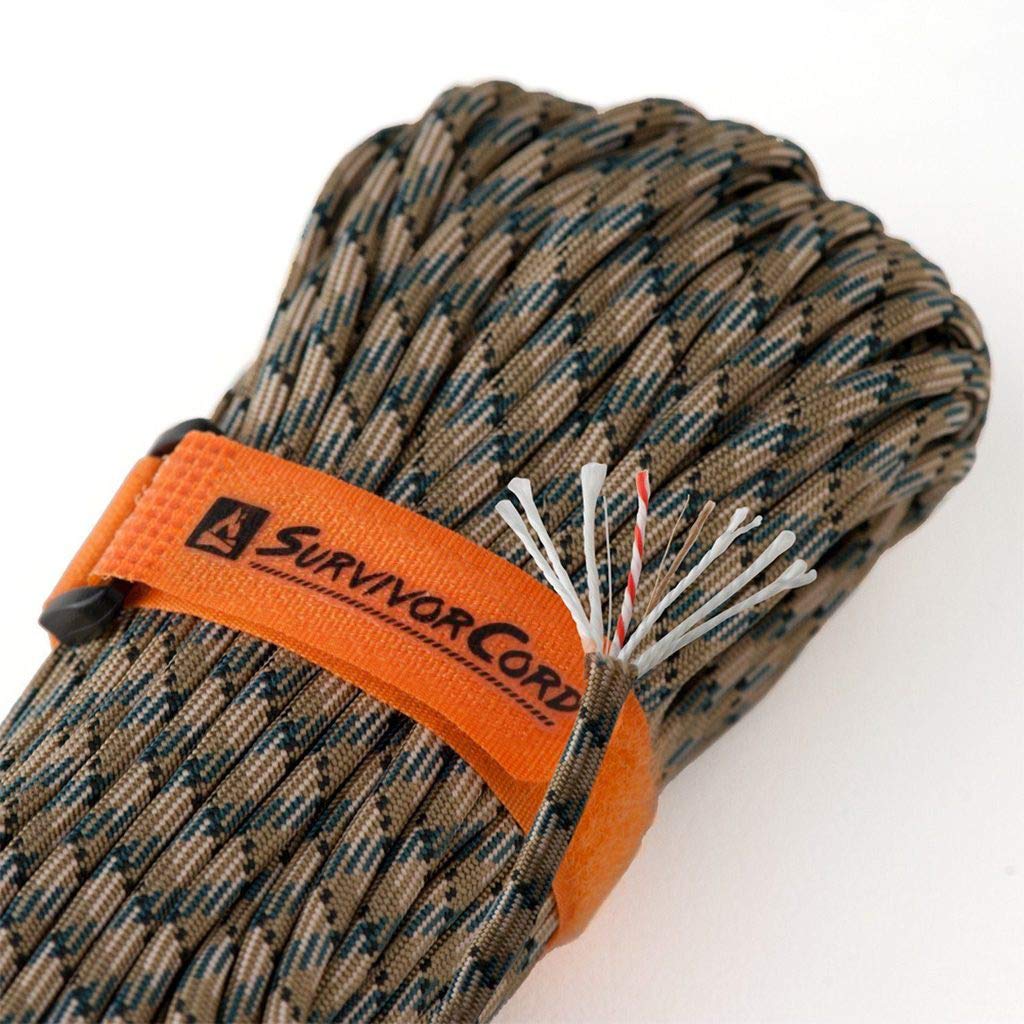
TITAN Survival Patented Paracord 550 – 25ft, 100ft, 500ft & Color Options – 620LB Strength Survival Paracord Military Spec with 3 Strands – Heavy Duty Hank Cord for Camping & Outdoors with Firestarter Forest Camo 100 FT Hank
PATENTED MILITARY GRADE DURABILITY – SurvivorCord is not cheap and for good reason. It is the original patented paracord, protected by US Patent 9,528,204. Designed in collaboration with Special Forces in Afghanistan, Designed to outperform, our MIL-STYLE paracord 550 exceeds MIL-SPEC requirements with a tensile capacity of 620 LB and three integrated survival strands. This strong military-grade parachute cord is perfect for survival, camping, & outdoor adventures. • MULTI-PURPOSE & VERSATILE – Whether you’re using it for securing gear, as a parachute cord, creating shelters, or emergencies, our tactical 550 paracord is incredibly versatile. It can handle any situation, offering superior functionality compared to standard para cord. • 3 INTEGRATED SURVIVAL STRANDS – Our survival paracord includes three life-saving strands: a clear and transparent 25-LB mono-filament fishing line, 30 AWG metallic alloy utility wire and a waterproof, paraffin-imbued, twisted jute fiber strand for starting fires anywhere, making it essential for any wilderness survival kit.
The clove hitch provides quick attachment to poles, trees, or stakes, though it requires understanding of its limitations to use safely. Cross the working end over the standing line to form an X, wrap around the object again in the same direction, then tuck the working end under the second wrap. This knot excels for starting lashings, temporarily securing items, or creating multiple attachment points along a ridgeline. However, the clove hitch can slip under variable loads or when tied around smooth poles, so it works best for applications where load remains constant or when backed up with additional security. A real-world example demonstrates its value: when building an emergency shelter frame, you can quickly attach multiple crossbars to vertical supports using clove hitches, then reinforce critical joints with square lashing for a structure that goes up fast but remains secure.
Common Failures and Critical Safety Considerations
The most dangerous mistake survivalists make with paracord knots involves using the wrong knot for the application, particularly substituting binding knots for load-bearing applications or vice versa. A square knot, despite its popularity, should never be used as a bend to join two ropes under load because it can capsize and fail catastrophically—it’s designed exclusively for binding applications like securing bandages or bundling items. Similarly, using a simple overhand loop instead of a proper bowline for a critical anchor point reduces your effective rope strength by half and creates a knot that may become impossible to untie after loading. Create a mental checklist before tying any knot: What force will this experience? Does it need to be adjustable? Must I untie it later? Will it face shock loading or constant tension? Answering these questions guides you toward appropriate knot selection.
Improper knot dressing represents another critical failure point that even experienced outdoorspeople overlook under time pressure. Dressing a knot means arranging all the rope parts so they lie properly without crossing, twisting, or creating stress concentrations. An undressed knot may look correct but perform unpredictably under load, potentially reducing strength by an additional twenty to thirty percent beyond the knot’s inherent efficiency loss. After tying any knot, take fifteen seconds to trace each rope segment, remove twists, ensure parallel lines run truly parallel, and snug everything firmly before applying load. This habit becomes especially critical with paracord’s slick surface, which allows poorly dressed knots to shift and rearrange themselves under tension in ways that can lead to failure.
A cautionary tale from search and rescue operations illustrates these principles starkly. An experienced hiker attempting to lower a pack down a steep section tied what he believed was a secure knot joining two paracord lengths. Under the pack’s weight, the improperly tied sheet bend slipped, sending essential gear tumbling into a ravine and leaving the hiker without shelter or food for an unplanned overnight in deteriorating weather. Investigation revealed he’d tied the knot backward, with working ends exiting on opposite sides rather than the same side—a subtle error that completely compromised the knot’s holding power. This incident emphasizes why practicing knots until muscle memory takes over proves essential, because field conditions rarely provide ideal circumstances for careful knot tying.
Building Practical Knot Mastery Through Progressive Training
Your journey to knot mastery follows a logical progression from controlled practice to field application under increasingly challenging conditions. Begin by learning each of the five essential knots individually in a comfortable indoor environment where you can focus entirely on technique without distractions. Use contrasting colored paracord initially so you can easily distinguish working end from standing line, and practice each knot twenty times in succession until your hands remember the motions without conscious thought. This foundation phase typically requires two to three focused practice sessions of thirty minutes each, spread across a week to allow motor learning to consolidate between sessions. Quick wins during this phase include successfully tying each knot from memory and achieving consistent results where every repetition looks identical to the last.
The intermediate phase introduces variables that simulate field conditions while maintaining safety margins for learning. Practice tying knots with gloves on to simulate cold weather conditions where dexterity suffers. Work in dim lighting using a headlamp to replicate dawn, dusk, or nighttime scenarios. Set a timer and challenge yourself to tie each knot within specific time limits, gradually reducing the allowed time as proficiency increases. Introduce wet paracord to understand how moisture affects grip and knot behavior. These progressive challenges build the adaptability you’ll need when tying knots in actual survival situations where conditions rarely prove ideal. This phase extends over several weeks of regular practice, with each session introducing one new variable while reinforcing previously mastered skills.
Long-term mastery requires regular field application where you use these knots in real outdoor scenarios with actual consequences for failure. Every camping trip becomes a training opportunity—use a trucker’s hitch for your bear bag, bowlines for tarp corners, taut-line hitches for guy lines, and challenge yourself to build entire camp systems using only the five essential knots. This practical application reveals nuances that controlled practice can’t teach, like how different anchor points affect knot performance or how weather conditions influence your technique choices. Maintain a practice schedule even during periods without outdoor trips by incorporating knot work into daily routines—practice while watching television, during lunch breaks, or any time you have paracord and five minutes. The goal is making these knots so automatic that you can tie them correctly under the stress, fatigue, and adverse conditions that characterize genuine emergencies.
Frequently Asked Questions
What is the strongest knot for paracord?
The bowline maintains approximately seventy-five to eighty percent of paracord’s original breaking strength, making it one of the strongest practical knots for creating fixed loops. For joining two ropes, the double fisherman’s knot retains the highest strength but proves more difficult to untie after loading. The key is matching knot selection to your specific application rather than always choosing the theoretically strongest option.
How many paracord knots should a beginner learn first?
Beginners should master five essential knots before expanding their repertoire: the bowline for fixed loops, trucker’s hitch for mechanical advantage, sheet bend for joining ropes, taut-line hitch for adjustable tension, and clove hitch for quick attachments. These five knots handle approximately ninety percent of survival and camping applications, providing a solid foundation before learning specialized variations.
Why do my paracord knots keep slipping?
Knot slippage in paracord typically results from three factors: using knots designed for natural fiber rope without modifications for synthetic materials, failing to properly dress the knot before loading, or choosing inappropriate knots for the application. Paracord’s smooth nylon sheath requires extra attention to knot dressing and sometimes additional security wraps compared to rougher traditional ropes.
Can I use the same knots for all types of paracord?
While the same knots work across different paracord types, you may need to adjust technique based on diameter and construction. Thinner paracord like 275 or 325 may require additional wraps in friction-based knots, while thicker paracord demands more careful dressing to prevent bulk from interfering with proper knot geometry. Military-spec 550 paracord with seven inner strands performs most predictably with standard knot techniques.
How do I practice paracord knots effectively?
Effective practice involves repetition in progressively challenging conditions. Start with twenty consecutive repetitions of each knot in good lighting until you achieve muscle memory. Then introduce variables like gloves, darkness, time pressure, and wet conditions. Finally, apply knots in real outdoor scenarios where they must perform actual functions. Regular practice sessions of fifteen to thirty minutes several times weekly build lasting proficiency faster than occasional marathon sessions.
What’s the difference between a bend and a hitch?
A bend joins two rope ends together to create a longer line or repair broken cordage, with both rope ends playing active roles in the knot structure. A hitch secures rope to an object like a tree, pole, or carabiner, with the object itself forming part of the knot’s structure. Using a bend where you need a hitch or vice versa typically results in poor performance or outright failure under load.
Mastering essential paracord knots transforms your survival capability from theoretical to practical, giving you the confidence to handle shelter building, gear securing, and emergency situations with competence rather than hope. The five knots covered here—bowline, trucker’s hitch, sheet bend, taut-line hitch, and clove hitch—form a complete toolkit that addresses virtually every cordage challenge you’ll face in wilderness environments. While learning these techniques requires dedicated practice, the investment pays dividends every time you’re in the field, whether you’re setting up a comfortable camp or responding to genuine emergencies where proper knot work makes the difference between success and failure.
Ready to put your knot knowledge into practice? Explore our comprehensive guides on shelter building techniques and gear selection to complement your growing paracord skills, and discover how proper equipment combined with solid technique creates true wilderness self-reliance.